
To shape an equitable and effective retail corridor recovery, public policies should be tailored to local conditions to support near-term reactivation and longer-term business survival.
By Candace Damon, Catherine Nagel, and Claire Summers
The impact of the COVID-19 crisis on municipal fiscal health will be extraordinary. With large portions of municipal expenditures mandated by state or federal law, discretionary spending will be highly constrained, and agencies that rely on unrestricted funds – fire, police, sanitation, schools, and parks – will be competing to establish the essential nature of their services. Historically, park systems have fared poorly in these competitions, and preliminary municipal budgets from around the country suggest that this crisis will prove no different, absent effective advocacy.
The last generation of park activism shows what effective advocacy looks like: many park and recreation systems have become more resilient to fiscal shocks by adding new sources of operating revenue. These include locally-specific sources of additional public funding (e.g. dedicated tax surcharges), contributed income (e.g. memberships and sponsorships), earned income (e.g. facility rentals and events), and “value capture” of a portion of the dollar value estimated to have been created by particular parks (usually those that could be shown to have created higher commercial real estate values). As we enter the coming fiscal crisis, park systems that have built strong partnerships with non-profit and private entities and diversified sources of revenue should emerge stronger than those that did not, but the peculiarities of COVID’s impacts suggest that all of these new revenue streams are also at risk in the coming months and years.
So with the General Fund shrinking; earned income at risk because its generation requires activities proscribed by social distancing; contributed income under pressure due to multiple demands on it; and the short to medium-term health of urban commercial real estate markets uncertain, where will park systems’ funding come from?
We should make the case to philanthropy, primarily local philanthropy, that supporting urban park systems now is an opportunity to advance long-term structural change. We spoke to three foundation program officers who currently support urban parks at significant scale, asking them to comment on the values parks foster that most resonated with them and the conditions under which they would consider increasing their support for parks and park systems. They were unanimous and emphatic in citing the potential for park systems to improve public health – physical and mental health and access to healthy food – and provide equitable access to an inclusive public realm. In the latter case, all interviewees stressed a broadening of the meaning of the words “equity” and “inclusive” to encompass not only the much-discussed 10-minute walkshed, but also concepts like establishment of broadband ubiquity in parks, partnerships with entrepreneurs and locally owned businesses to build community wealth, and close examination of the equity implications of some recreation being more conducive to post-COVID play (e.g. golf) than others (e.g. basketball).
The potential of philanthropy should not and cannot take local government off the hook: our public park and recreation systems need public funding. To paraphrase one of our interviewees, “We are not going to simply plug public budget shortfalls. We are philanthropists. The difference between charity and philanthropy is that philanthropy should change the conditions that led to the problem. Charity gets you the service you need. Our job is to challenge our grantees to retool to better serve their mission and then get them started.”
Philanthropy can help advocates make the case that public dollars should be allocated to reflect our values. Parks provide or have the potential to provide services more equitably, effectively, and efficiently than how those services are typically provided, including by public safety and criminal justice entities; private healthcare providers and insurers; and providers of aspects of food security/agriculture, affordable housing, and climate change/resilience services. Initiatives that demonstrate the integral nature of parks in urban life – and recognize the fiscal implications of those initiatives – are already gaining attention. LA County’s Parks After Dark (PAD) Program gives young adults a place to congregate safely at night. The LA County Parks Department and Sheriff’s Department believe that the program has meaningfully reduced crime and saved the County $2.2 million in criminal justice costs in 2018. In Philadelphia, rather than spending $9.6 billion on “gray” infrastructure to fix the city’s deteriorating stormwater system, the Water Department is spending $2.4 billion to integrate green solutions on public and private properties throughout the city, including 500 acres of public parks. Advocates need to insist that these and other efficiencies inure to the benefit of park systems’ budgets.
Racial equity will be central to any fruitful argument for increased funding of parks; any such argument must grapple with the often problematic record of parks and park systems on this front. We and others have written about this history elsewhere. Historic disinvestment has left many low-income communities and communities of color without access to quality parks and recreation opportunities and with park assets in need of significant upgrades. Both recent and historic park investment has tended to prioritize affluent neighborhoods, central business districts, and communities where “transformation” was hoped for. Examples are legion and date from at least Reconstruction and the origins of Plessy v Ferguson. Central Park owes its birth to the use of eminent domain and displacement of residents, including a 225-person mostly African American community. Mac Miller’s Blue Slide Park speaks to the amazing playground (that Candace grew up playing in) in Pittsburgh’s affluent Squirrel Hill. Opened in 1962 and billed as the “most imaginative” of the city’s contemporary wave of investment in public parks, in 1967 it was the site of a “play-in” by Black North Side children protesting their complete lack of playgrounds. In recent weeks, multiple reported incidents in urban parks across the country have reinforced the notion that public parks are White space, and activities acceptable when undertaken by White people are not when undertaken by people of color. Of course, our urban parks also improve mental and physical health, mitigate the impacts of climate change, lower crime rates, and make a city more attractive to employers. They can, and when well-designed and programmed frequently do, create a more inclusive public realm, including by providing places for emergency response, protest and celebration. City Parks Alliance, HR&A and others have sought to elevate these values while being mindful of more fraught legacies, creating playbooks for progress.
Successful advocacy for increased funding of parks will also require data-driven approaches. All of our program officer interviewees agreed that a quantitative demonstration of achievement of the broadly-defined values of a park or park system would be powerful, including performing the data collection and analysis needed to make that demonstration. Credible analyses of the benefits cited in this article have been performed in discrete instances across the country. HR&A has shown that parks investment in a LMI Black neighborhood – when driven by community priorities for that investment and overseen by community stakeholders – can help stabilize or grow Black population and create wealth for Black homeowners through single family home appreciation, while also welcoming new, non-Black residents. The City of Dallas is currently seeking to better understand its park systems users, including their demographic and geographic characteristics. City Parks Alliance has built on many of these analyses to create a framework for developing, implementing, and evaluating a data-driven equitable investment park strategy. We need to make these kinds of analyses and the communication of their results a standard component of advocacy. In the short term, this means message testing and leveraging voices from across sectors, including health, housing, business, and resilience to communicate the breadth of parks’ value and of the diverse coalition supportive of parks.
The coming fiscal crisis is an opportunity to reimagine urban park systems to achieve long sought goals of public safety, public health, equitable economic development, inclusive access, and environmental resilience. Now is the time to strategize, collaborate, and implement actions that will recognize those values.
Written by Andrea Batista Schlesinger and Mary Jiang
City leaders are being called upon to use the power they have to make systemic changes. One power examined far too infrequently comes in the form of the billions of dollars that flow through city coffers and then through the commercial banks that manage local government transactions. The actions of commercial banks shape cities and their economies more than any mayor’s economic development policy. Historically, these actions have reinforced White ownership and Black poverty.
The relationship between banking and inequity consistently surfaces in our work. For example, the average loan approval rate for White business owners is 19% higher than for Black business owners and only 49% of Black-owned firms survived the past recession, compared to 60% of White-owned firms. As Black protestors have argued in response to the looting that has coincided with the peaceful protests of George Floyd’s murder at the knees of police, “[These buildings are] not ours. We don’t own anything. We don’t own anything.”
The lack of Black ownership, even in Black communities, is not a coincidence. The role of private finance in the perpetuation of racial disparity did not end with redlining—race and racism remain encoded in seemingly neutral concepts, such as financial “opportunity” and “risk.” The wholesale purchase of financially distressed homes in low-income Black communities presents an “opportunity.” Yet Black and Latinx households are less likely to qualify for conventional mortgages than White applicants even when controlling for income and loan size, because they pose a greater “risk.” Predatory lending to Black communities presents an “opportunity.” Yet because of historical and structural bias amounting to perceived “risk,” Black and Latinx entrepreneurs receive lower levels of conventional business financing, are discouraged from entering capital markets, and are underrepresented in business ownership.
These patterns intensify in the aftermath of natural and economic disasters. In the Paycheck Protection Program’s first round, businesses owned by people of color were disproportionately and functionally excluded from federal aid because they did not have relationships, or large payrolls, with mainstream banking institutions. Only 12% of Black and Latino business owners who applied for COVID-19 relief aid from the Small Business Administration reported receiving what they had asked for. These barriers have had lasting effects on the second round of funding, compounding the challenges of recovery. Despite these gaps in service, banks have profited from being the only options for their services: in the PPP’s first round alone, banks earned $10 billion in fees for processing essentially zero-risk loans with reduced vetting requirements.
We cannot make cities more equitable until we confront the role of private capital in perpetuating racism. As banking reform advocate Ameya Pawar argues, every decision a bank makes to lend or not lend, invest or not invest, serve or not serve, amounts to an economic development policy. Cities can influence these decisions by committing to full transparency about the accounts they hold with commercial banks, leveraging the scale of their accounts to influence commercial banks to reform lending practices, diverting public funds to local and regional banks and Community Development Financial Institutions (CDFIs) that meet the gaps left by large commercial banks, and providing essential technical assistance to build financial capacity in underserved communities.
Beyond these steps, some have urged local governments to create an alternative to commercial banking altogether by depositing government funds in, and processing their transactions through, public banks that are owned and operated by cities or states, oriented toward the public good, and directly accountable to publicly elected bodies. In the U.S., advocates have argued that public banks could serve as alternatives to commercial banks while collaborating with mission-aligned financial institutions such as local banks, credit unions, and CDFIs. Public banks could resist the prevailing risk/return principles defined by private loan terms to drive low-interest loans and investments in Black and Brown communities that have been disqualified from the most basic levels of financial support.
We have begun to explore how public banking might work in cities across the country. We evaluated the feasibility of a public bank for the City of Seattle and are currently doing so for the City of Philadelphia. In Seattle, the primary motivation to explore an alternative to commercial banking was to divest from Wells Fargo, which had been instrumental in funding the Dakota Access Pipeline. In Philadelphia, where we estimated a small business lending gap far greater than any suite of public programs could fill and where only 5% of bank and credit union branches are located in low-income, majority-minority neighborhoods, city leaders are interested in addressing deeply entrenched, racialized poverty by seeing how their dollars could leverage investment in local businesses that would create local jobs.
Setting up public banks is not easy, and while advocates for public banks inspire us to think boldly, oversimplifying the feasibility of establishing such institutions will not advance racial and economic equity. The credit rating agencies emerged powerfully from the 1970s’ urban fiscal crises to limit government risk, effectively exerting a stranglehold on city spending and making it difficult for cities to secure the initial dollars to capitalize a bank. The heralded Bank of North Dakota, the country’s longest running and most successful public bank, took 30 years to become profitable and owes much of its initial momentum to the state’s agriculture and oil industries. Many jurisdictions, particularly cities, are fighting for a public bank in fundamentally different economies. The U.S. still lacks a precedent for a City-owned public bank, and many cities face state-level preemption challenges and limited scale of deposits, compared to state counterparts.
Local, state, and federal banking policy change will be necessary to facilitate the creation of public banks. Change is necessary because we are committed to helping cities become less dependent on private actors, such that they have a choice about how to conduct business in ways that are consistent with their values. In this way, we see our ongoing public banking work as a way of advancing the autonomy and creativity of municipal governments, and the possibility of those who live in cities to hold them accountable. Which is to say, the case for public banks is as much about supporting the use of banking powers in the public interest and challenging a commercial banking system that has profoundly failed—at scale—to move capital to advance racial and economic justice, as it is about actually setting up such banks. Perhaps even the rhetorical threat of a public bank might inspire commercial banks to embrace an anti-racist future for the cities they serve. If it doesn’t, more and more cities will begin to take their financial power elsewhere.
Our industry must embrace racial equity and shared prosperity as its core mission
I have spent much of my career working with local governments to shape inclusive economic development policy. The events of the past month have caused me to question traditional approaches to economic development, even the most progressive. A seismic shift is required for the economic development profession to contribute to ending systemic racism rather than continuing to perpetuate it.
Written by Cary Hirschstein
Most state and local governments deploy economic development resources to attract new jobs and secure capital investment. The term “trickle-down economics” has typically been reserved for federal economic policy, but most state and local economic development regimes follow a similar formula: we assume that if we grow the economy, we will generate opportunity for all and/or expand fiscal resources to support communities in need. Cities seek to attract high-wage jobs because they will pay higher taxes and drive greater spending within the local economy. This approach is built on a faulty premise: that growth yields equitable prosperity.
Economic development policy has transformed the American city while deepening racial divides. The core visions, initiatives, and tools of economic development have facilitated the return of investment to our downtowns, creating vibrant places where talent wants to be and businesses want to grow. At the same time, the imperative to “build on strength” tends to steer resources to White neighborhoods and central business districts. Prior to recently enacted policy changes, we found that parcels in one affluent, predominantly White neighborhood in Columbus, OH were three times more likely to have received property tax abatements than a comparison set of less affluent, predominantly Black communities. In Houston, 10% of the city’s property tax base is collected within its 26 Tax Increment Reinvestment Zones (TIRZ). The four wealthiest TIRZs combined retain more tax increment than the remaining 22, which they are able to reinvest locally. Studies examining federal expenditures to promote economic mobility show that benefits accrue predominantly to middle- and higher income households and limit intergenerational mobility for low- and moderate-income families.
Equitable prosperity is not a core mission of most “economic development” departments; rather it is the domain of “community development” entities. Although some cities have begun to merge community and economic development functions, they remain for the most part siloed. Economic development functions are generally better resourced than community development. Programs like workforce development and small business support that don’t involve headline-garnering, multimillion-dollar deals are often shunted to the margins of agency hierarchies.
Economic development professionals must embrace creation of shared prosperity and an equitable economy as core missions. Some City-led economic development departments have begun to employ equity as a primary lens for evaluation and deployment of their resources. We need to ensure these practices become the norm across the country, but also that they go far deeper to disrupt systemic racism. While we continue to invest in the renewal of our cities, we must also ask: who do our investments benefit, and how can those benefits be more equitably distributed? I offer five responses:
- Shift resources to investments that promote racial equity. Cities should view their economic development expenditures and assets as an investment portfolio, a primary objective of which is to create more equitable local economies. Realizing this objective will require a close examination of the beneficiaries of past investments; a deliberate shift in target recipients, geographies, and tools deployed to reach them; and far greater transparency and accountability for the deployment of resources. The potential impact is immense. A 2016 New York Times study estimated that state and local governments provide $80 billion annually in business incentives. The foregone revenue of the 10 states with the largest tax breaks is equivalent to the annual salaries of 27,000+ teachers.
- Articulate our values, use them to structure investments, and measure their actual benefits. We need to state what we expect of those doing business in our cities and insist, not just hope, that economic growth be a springboard for equitable opportunity. For those incentive deals we choose to do, requirements that provide strong, measurable public benefit should be the norm without exception. For example, New York City and State’s efforts to attract Amazon established no clear relationship between incentives offered and community benefits, which would still be true were a similar opportunity to be presented today. In contrast, Prosper Portland reformulated its mission, values and programs over the past five years to make racial equity the foundation of its work. All recipients of Prosper Portland’s largest incentive program, Enterprise Zone, execute a public benefits agreement. Companies can choose from a menu of options to fulfill their agreement, including creating a diversity hiring plan, engaging with local schools, and hosting events to support entrepreneurship. Initial results are promising, in part because companies wish to attract a younger talent pool that seeks employers with principles that align with their own.
- Promote equitable access to jobs. There is a broadly shared understanding today that human capital is core to the future of local economies and that businesses follow talent. It is therefore incongruous that our economic development entities remain focused on attracting businesses rather than cultivating our workforce. Studies suggest that customized business services such as job training are as much as 10 times more effective than incentives in influencing business location decisions. To aid economic mobility, economic developers should target industry expansion opportunities that align with pathways for the existing workforce and also invest in upskilling. Cities must provide protections for low-wage workers – disproportionately Black and female. Indianapolis recently repositioned its core economic development incentives to prioritize a higher minimum wage, health and childcare benefits, workforce training, and community partnerships.
- Invest in small businesses, with an emphasis on businesses of color. As the enormity of the COVID-19 pandemic became clear, Philadelphia distributed $13.3 million in grants and zero-interest loans to 2,000 small businesses, more money than it had distributed to all businesses citywide in the past 10 years through its primary job creation program. Indy Chamber issued $6 million in small business loans, a 15-fold increase over loan activity in a typical year. In both cases, the majority of recipients were businesses of color – 75% in Indianapolis and 60% in Philadelphia. Economic development leaders with whom I’ve spoken share the view that efforts to rebuild small business strength must be sustained. A focus on minority entrepreneurship is critical to counter structural disparities. According to Brookings, Black people represent only 4.3% of the nation’s business owners despite being 12.7% of the U.S. population, and if businesses in Black communities earned and grew at the same rate as in other neighborhoods, they would see an additional $3.9 billion in annual revenue. Providing the financial and technical support to grow more Black-owned businesses will mean looking to models like Oakland, CA’s Black Arts Business and Movement District, which established a development corporation and impact fund to support Black artists and business owners.
- Transform economic development ecosystems. Community development is economic development, and cities’ institutions should align mission and coordinate investments in currently siloed entities to recognize that fact. In many cases, disruptive change will be necessary to inject new voices, establish new priorities, shift budgetary allocations, and truly transform systems. Public organizations must hire and promote leadership and staff that is more reflective of the demographics of their cities, and we must carefully consider whose voices and analyses are elevated as we refocus our work. Investments in capacity-building for local partners within the larger economic and community development ecosystem will be critical to ensure a more robust infrastructure.
There is great urgency to this work. We have seen how underlying economic inequities, matched with the indignities of the criminal legal system, have gotten us to a boiling point in our cities. The road ahead requires taking decisive action to promote racial equity and shared prosperity, including ending a decades-long experiment in economic growth absent a real commitment to equity.
Special thanks to Andrea Batista Schlesinger, Candace Damon, Leah Elliott, Gail Hankin, Jeff Hebert, Kyle Vangel, and Mary Beth Williams for their intellectual and analytic contributions to this article.
Written by Eric Rothman
Our firm and our collaborators in sister disciplines have a shared responsibility to interrogate our roles in perpetuating racist systems in urban development. The Urban Land Institute (ULI), the oldest and largest network of cross-disciplinary real estate and land use experts in the world, should be a leader and collaborator in this effort – acknowledging our history and providing guidance for moving forward. This is especially true given the organization’s:
- Reach – Founded in 1936, the most prestigious membership organization in the industry, today with 45,000 members, many active locally in District Councils and nationally in Product Councils;
- Mission – “provid[ing] leadership in … sustaining thriving communities worldwide;” and
- Influence – hired every year by scores of governments and land owners as consultants who, organized into Technical Advisory Panels (Urban Plan and Advisory Services), tackle local development problems and whose recommendations are frequently adopted.
Regrettably, ULI has not yet exercised any leadership on the issue of systemic racism in urban development or even turned the mirror on itself.
A case in point: ULI’s inadequate and disturbing message of last week entitled “Time for Change.” In contrast to the thoughtful notes of partner firms in fields that have long been White-led, struggling with their part to become anti-racist, ULI’s disappointing communication failed to name racial injustice as a specific plague, acknowledge our industry’s racist history, or commit to any concrete actions. Likewise, ULI’s most prestigious individual award, the J.C. Nichols Prize for Visionaries in Urban Development, is named for a developer and philanthropist who perfected the use of restrictive covenants. His tool was adopted by our federal government and financial institutions to establish and enforce redlining throughout the United States. Despite pressures, ULI has to date resisted renaming the prize, an obvious first step toward healing and redress in the industry.
HR&A and its employees have been members of ULI for at least 25 years. Along with several of my partners, I serve in leadership roles in ULI. We are building a coalition of allied firms that are committed not only to institutional change within our organizations but also to promoting anti-racism in the industry. Our coalition is starting with a call for change at ULI, which is both necessary for our industry and can secure a more sustainable future for ULI.
Our agenda for change at the Urban Land Institute includes:
- First Steps Needed for Structural Change to Take Hold: Rename the J.C. Nichols Prize immediately, starting with the 2020 honoree. Prohibit programming that features panels comprised only of white men. Appoint a senior executive to lead a team responsible for racial equity, diversity and inclusion within ULI and its work.
- Acknowledgment of the Role that ULI and its Members Have Played in Racial Injustice: Commit to meaningful self-examination, including requiring all District Council and Product Council leaders to attend Diversity & Inclusion / Racial Equity training. Expand the racial diversity of members and commit to increased diversity in the industry through targeted recruitment and scholarships.
- Commitment to Concrete Actions to Achieve Systemic Change and a Timeline to Which ULI Will Hold Itself Accountable: Launch a Racial Equity initiative for research and best practices, funded at least on par with ULI’s Building Healthy Places, Urban Resilience, and Housing Centers initiatives. Strengthen outreach and assistance to communities of color through Urban Plan and Advisory Services, with the specific aim of redressing racial discrimination in urban development. Expand Urban Plan to be more than a primarily a volunteer-driven effort, for example by hiring Urban Plan fellows who can provide sustained outreach to schools in communities of color. Showcase more projects in Spring/Fall Meetings and Awards that are community-based and incorporate anti-displacement efforts.
Consistent with our A Just & Resilient Recovery Framework, our firm, our country and its cities remain in emergency response mode, but we must see this moment through to institutionalization of structural change. Indeed, if HR&A had institutionalized an approach to anti-racism earlier – had done more than have a vision for diversity; establish Employee Resource Groups for our Asian-American/Pacific Islander, Black, Queer and Women employees; and conduct Diversity, Equity & Inclusion training – the past few weeks could have been more healing and less traumatic for our firm. This is the very definition of resilience.
We recognize that our late embrace of anti-racism has implications beyond our firm doors; it extends to the cities that we have worked in. On this, our partner firms and ULI share responsibility. We need real leadership from ULI in this “time for change.” Without it, either the industry will remain stuck, fragile, and lacking in resilience; or we will move forward and leave ULI behind with its J.C. Nichols Prize, a monument to another time.
We humbly stand in solidarity with Black communities that have been fighting for over 400 years against state-sponsored violence and systemic racism in all forms.
A Just & Resilient Recovery began as our framework to help address the economic crisis in cities caused by the COVID-19 pandemic, and to achieve equitable outcomes in the process. The past week has underscored the imperative of racial justice as a prerequisite to the recovery we seek.
We are reflecting on our role as well as that of our field in perpetuating White supremacy. We commit to take action in the coming days, weeks, months, and years to reshape our firm and the ways we work with communities to advance racial justice. As a first step, we have begun convening an Anti-Racism Working Group to hold our firm accountable to the hard work ahead. We have also established a Solidarity & Action Fund, which will invest in anti-racist advocacy organizations and be distributed under the guidance of staff in our Black Employee Resource Group. Moving forward, we commit to reaching out to and learning from our partners and collaborators who have deep experience dismantling systems of oppression and who are helping to organize and support protests, vital reforms, and communities of color.
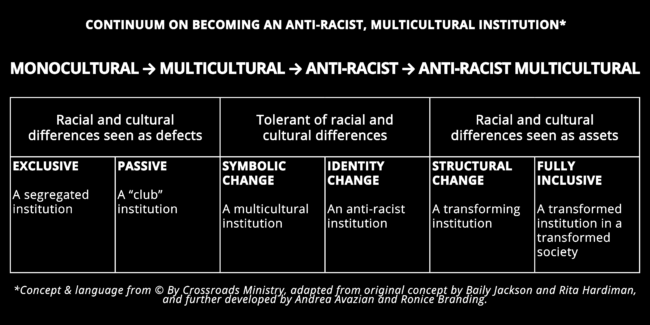
Below, we have included a framework that HR&A is referencing as we begin the work of becoming an anti-racist multicultural organization. We share this as a resource and a starting point for conversation with you.
Written by Kate Wittels, Jessica Jiang, and Renee Barton
Over the past few months, digital tools have become indispensable to those who can accomplish their jobs digitally. As stay-at-home orders were put in place across the country, some Americans, many of whom were white, more educated, and higher income, were able to trade the open office for the open kitchen. For those workers, over half would prefer to continue to work remotely; Germany is considering mandating that all workers have the option to continue to work from home post-pandemic; and Twitter has announced that its employees will have the option to continue working from home indefinitely. In contrast, other workers, often lower-income, female, and non-white, were unable to conduct their work virtually and had to choose between a paycheck or exposure to the virus.
Recent studies from the St. Louis Fed and the University of Chicago’s Becker Friedman Institute estimate that between 33% and 37% of all occupations can be conducted virtually. While some occupations can easily transition to virtual work, such as web developers, accountants, and writers, jobholders in many other occupations, such as teachers, health care providers and researchers, will tell you that, while they can technically work from home, they cannot do their jobs effectively with only a home laptop and residential internet access.
To understand which occupations can work effectively from home and which cannot, we evaluated Occupational Information Network (O*NET) work activity profiles to develop the following four categories of occupations: (1) jobs with the ability to conduct work virtually today, (2) jobs with the ability to conduct work virtually with additional investments or planning, (3) jobs that cannot be conducted virtually and are non-essential, and (4) jobs that cannot be conducted virtually and are essential. We classified all occupations based on these four classifications, evaluating the distribution of jobs across classifications, and considering income, ethnicity, gender, educational attainment, and broadband access.
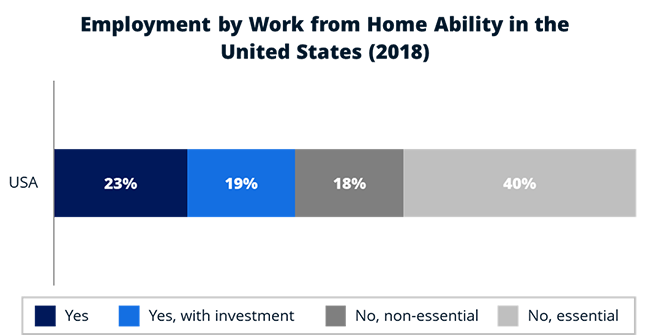
We conclude that a somewhat higher percentage than assumed by the St. Louis Fed and U. Chicago Becker Friedman Institute could work remotely, but that doing so effectively will require investments in universal access to high-speed internet, comprehensive training on virtual tools, and more user-friendly technology. Nationally, we believe only 23% of all jobs can easily transition to work from home effectively – i.e. in the midst of this pandemic, only 23% of American workers are able to perform their jobs at full productivity from home. If there were universal access to high-speed internet, comprehensive training on virtual tools, and more user-friendly technology, we estimate that an additional 19% of jobs could be performed productively in a virtual environment.
Included in this 19% are both jobs where the technology exists, but the training does not (e.g. teachers), and jobs that require technological innovation (e.g. scientists). Nearly a third of these workers (9 million) are in educational occupations, 1.2 million are in health care, and nearly 900,000 are scientists and researchers. While these jobs span a wide range of average income levels – from $46,000 for social service occupations to more than $100,000 in legal occupations – these are mostly middle-class jobs with a median wage of $55,000.
As we recover from COVID-19, and policymakers craft strategies to invest in universal broadband to build long-term resilience, they will need to remember that:
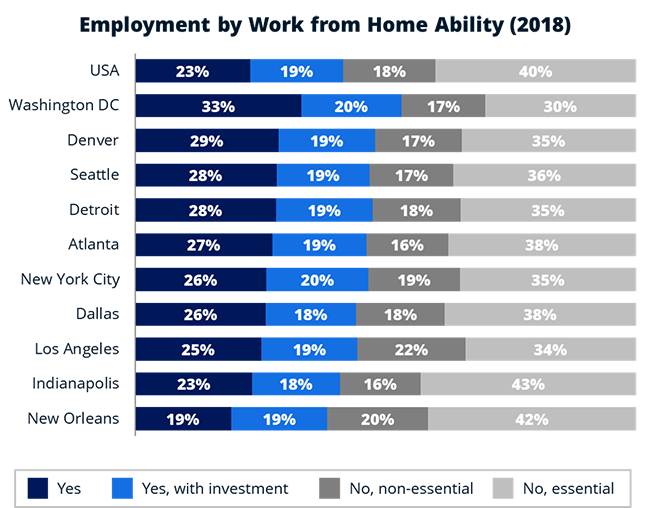
- Not all cities are created equal. In New Orleans, where the economy is driven largely by tourism, hospitality, and service jobs, only 19% of jobs can currently be conducted virtually. Conversely, in Washington DC, 33% of jobs can already be conducted virtually. If New Orleans prioritized universal broadband access, training, and technology development, an additional 19% of people could work virtually, meaning the overall share of the economy that could withstand future shocks would be closer to 38%.
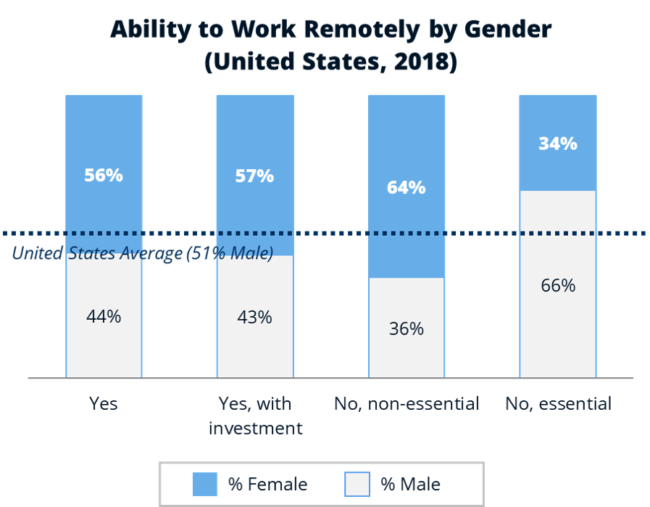
- Class and gender will need to be considered to obtain results that are both equitable and efficient. Currently, more than two-thirds of workers who could potentially work from home with further investments or planning cannot afford access to high-speed internet. Compounding the technological constraints, the majority of occupations that could work from home with better investment are performed by women (57% compared to a national average of 49%). With schools closed, the need for childcare and household support systems are needed now more than ever. Particularly in denser cities, many workers are finding their living arrangements too crowded to provide a quiet place to think.
- Race is unsurprisingly also a major differentiator of those who may benefit from remote working and those who will not. Nationally, non-white workers hold only 31% of jobs that can be conducted virtually, with or without investment. In the aggregate, jobs that cannot be conducted virtually pay less – an average income of $37,000 – and have lower educational requirements – 93% of these jobs do not require a bachelor’s degree. To ensure a more just and resilient recovery, reskilling programs will need to acknowledge racial inequities.
- Government will have to create markets, as it has in the past. Technological innovation has transformed numerous consumer products and services, such as food delivery and transportation. Widespread adoption of technology by institutional sectors such as education, health care, and government has not occurred at the same pace. This is in large part because conventional sources of capital (e.g. venture investors) have yet to formulate strategies to navigate these sectors, which often have numerous stakeholders with sometimes competing agendas and complex regulatory barriers. Our long, successful history of government investing in medical research, military technology, space travel, and other major innovations, and then seeing the payoff in citizen well-being, is a precedent to which we should turn.
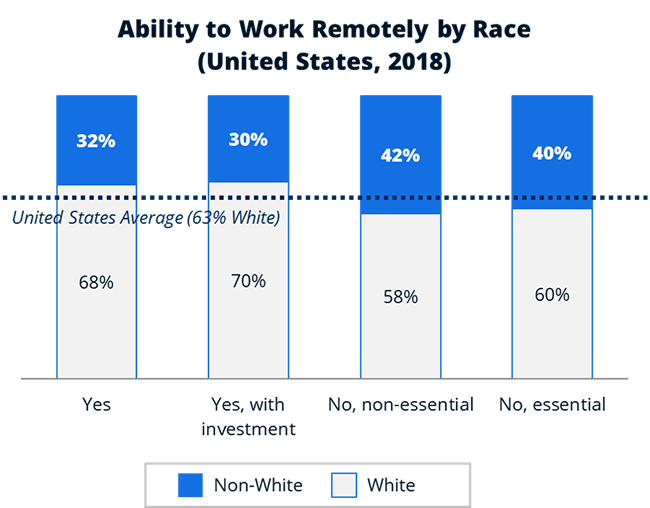
The COVID-19 pandemic is a reckoning for how we produce, consume, and learn. As a critical first response, to achieve magnitude of change needed, we need to tailor policy and funding approaches to local dynamics. Through strategic investments in high-speed internet, comprehensive training, and accelerated adoption of virtual technologies, more Americans could have the option to work virtually, allowing them to better withstand future shocks and enabling a more just and resilient path forward.
Written by Shuprotim Bhaumik and Kristina Pecorelli
With every passing day, it becomes clearer that the impacts of COVID-19 are exacerbating underlying inequities in American society. Understanding exactly which populations are most at risk in which localities will be important for fiscally constrained states and municipalities that need to target scarce resources equitably and efficiently. Rethinking how we approach economic impact assessment is critical to gaining that understanding.
Economic impact assessments (EIAs) estimate the impacts of projects, programs, and policies to support requests for investment. Results are typically expressed in terms of spending, jobs, and wages, and rely on multipliers that are based on observed economic relationships made over a period of time to show how changes in one segment of the economy reverberate throughout the rest of the economy. For instance, assume a jurisdiction proposes to use a tax abatement to secure the relocation of a back-office of a financial services firm: the analyst ascertains the number and types of jobs the firm proposes to bring to the location (“direct jobs,” e.g. accountants), then employs a model to estimate the number and types of jobs that the firm will create through its spending (“indirect jobs,” e.g. legal services) and that the employees of the firm will create through their own spending (“induced jobs,” e.g. baristas).
In the COVID-19 era, EIAs can help civic leaders accurately assess the damage, make the case for funding, and ensure that recovery funds are spent efficiently and equitably. The challenges of impact assessments during COVID stem from the peculiar nature of the pandemic, which is rewriting the fundamental patterns of local economies in real time. The multipliers contained in the traditional models are likely no longer accurate: amidst select business closures, phased re-openings, and massive shifts in consumer demand, impacts will vary widely by type of business and even the nature of work within businesses. Some impacts may become permanent as the crisis reshapes how certain sectors operate in response to the global pandemic.
The American Reinvestment and Recovery Act, the federal response to the Great Recession of a decade or so ago, resolved this concern, which we believe to be far more fundamental now than it was then, by refusing to consider estimation of anything more than direct jobs in the EIAs it mandated to secure stimulus funds. We believe a more nuanced approach is possible, indeed required.
HR&A is currently working with Nassau and Suffolk Counties in New York to develop an approach to measuring the real-time impacts of COVID-19 on Long Island. The region has rapidly transitioned from the nation’s first postwar suburban district to more than a dozen distinctly different cities and townships with a population of 2.8 million. Long Island is also a more diverse place than it was decades ago, driven in part by a growing immigrant and non-white population. The jobs-housing balance has shifted to more job-intensity, and emerging health care, agritourism, biotech, and clean energy industries have replaced what was once a manufacturing-dominant region. Less positively, racial and income disparities and segregation in housing and schools have persisted. A lack of affordable housing is reinforcing a brain drain; young Long Islanders are leaving the region.
Working with leaders from both counties, we’ve developed an analytic framework that considers the initial economic shock from COVID-19, reflecting the impact of business shutdowns and subsequent reductions in consumer demand; differential rates of recovery, depending on when businesses are allowed to reopen and how well-positioned they are to resume full operations; and “new normal” levels of economic activity, which may be at, above, or below the pre-COVID levels depending on economic sector.
To apply this framework, we categorized all jobs within the regional economy according to unemployment risk. Expanding upon methods developed by the St. Louis Fed and UChicago Becker Friedman Institute, risk levels were assessed at the industry and occupation level, reflecting whether jobs were classified by public authorities as “essential” to public health and safety and thus “permitted” to remain open, can be performed off-site, and are salaried or wage-paying. For example, cashiers are typically considered an occupation at high risk of unemployment during an economic shock owing to non-essential status, inability of the job to be performed remotely, and hourly wage pay basis. However, this assumption does not hold true for grocery store cashiers in this (or most other) shocks. Hence, more careful examination of the effects of the pandemic is warranted to guide efficient, equitable policy response.
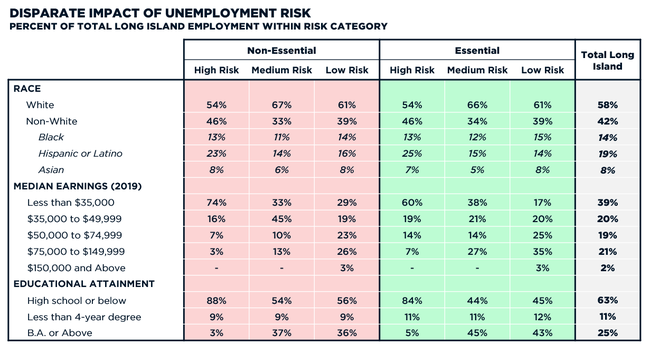
The table below shows the distribution of jobs on Long Island by high-, medium-, and low-occupational risk of loss and essential versus non-essential industry, a distribution we developed via consultation of cumulative weekly unemployment insurance claims, documented changes in monthly employment by sector available as of this writing, local and national survey data, and other sources portraying consumer behavior and demand responses under future public health scenarios.
By examining the characteristics of workers within occupations or industries at greatest risk of unemployment, we can also understand who is most likely to suffer economic losses (possibly in conjunction with poor health outcomes). As shown below, low-income, low-skilled workers, and to a lesser but still significant extent, Hispanic or Latino workers, are disproportionately affected by the economic shock of COVID-19 on Long Island. This is largely a function of the types of businesses that employ these populations—namely Retail, Accommodations and Food Services, and Arts, Entertainment, and Recreation—being among the most severely impacted by the initial economic shock of COVID-19. (If risk were equally—which would not equate to equitably—shared, the percentages across any given row should be equal or similar to the percentage for all local workers shown in the final “Total Long Island” column. Differences suggest areas for policy focus.)
While the unfairness of the virus’s effects—both physical and economic—are well-known, that a disproportionate share of jobs at high risk for unemployment are occupied by workers without a post-secondary education, while jobs with the lowest risk of unemployment are disproportionately occupied by workers with a bachelor’s degree or above, suggests that those at highest risk are also those most limited in their ability to find alternative job opportunities given their existing skill set. This suggests that retraining or reskilling initiatives need to be central to future recovery efforts on Long Island.
This exercise will undoubtedly prompt uncomfortable but crucial questions for recovery. For example, should we prioritize aid to sectors that are disproportionately impacted, but which tend to be lower-paying and offer fewer opportunities for economic mobility? Or should we double down on sectors with the highest economic multiplier effects, and focus instead on addressing the barriers to entry that have historically prohibited access by currently low-skilled workers? Should aid be based on the size of business or those that employ a disproportionate share of high-risk workers? Do concentrations of impact among low-wage workers suggest there should be a focus on housing, transit, and other cost factors that influence economic survival during a long-term recovery? What sorts of retraining or reskilling efforts will be required for jobs permanently displaced by the crisis, and which organizations are best equipped to run them based on the populations affected?
All of these questions are critical to an economic recovery plan. Answering them begins with a robust understanding of impact and its distribution. The impacts, their distributions, and therefore the answers that inform recovery will all vary by location.
Written by Andrea Batista Schlesinger
The word “recovery” seems innocuous, even positive, but masks a set of decisions that will be made by people in power, decisions that will seem either neutral or inevitable. Yet, in each and every one of these decisions there will be winners and losers. We must learn now what is meant by recovery, what decisions will be made, and how best to leverage our collective power to influence direction and, therefore, the future of our cities.
If history is any indication, the people who are suffering disproportionately now will continue to do so in the recovery. In New Orleans, 10 years after Katrina, predominantly black neighborhoods such as New Orleans East had regained only 60% of their pre-Katrina population, while predominantly white neighborhoods with similar flood impacts had largely rebuilt. One factor in this disparity was the Road Home program, which funded home repairs and buyouts based on pre-storm market value rather than replacement value – leading to similar homes with similar needs receiving different levels of funding that closely tracked pre-existing racial divides. Over time and across crises, these disparities compound: a 2019 longitudinal study found that, between 1999 and 2013, white Americans living in counties that experienced major storms saw their wealth increase by $127,000, whereas black Americans in the same counties lost $27,000 in wealth. Indeed, white Americans in these counties were significantly better off than white Americans in counties unaffected by storms, while the reverse was true for black Americans. These gaps were statistically significant even after controlling for a variety of personal and locational factors.
The phases of virus-related action will be emergency response, stabilization, recovery, and then institutionalization. At each stage, decisions will be made that will have profound repercussions even if they don’t seem to be of great consequence. In the current, response phase of action, communities have finally gotten access to more – but still inadequate – testing. But who gets tested, and how? Until recently, in New York City, arguably the best transit-served city in the nation, 1/3 of testing sites required a vehicle to access; 55% of New Yorkers – and as many as 80% of households in some low-income communities – do not have a car. Cities are letting people out of jail for public health and humanitarian reasons. But why is there no plan for where these people will go for safe housing and access to health care?
Likewise, as we move into the recovery phase: Will environmental regulations be relaxed in the name of securing a return to economic strength? Will recovery require dependence on the commercial banking channels that currently under-serve small businesses, notably those operated by people of color and women? How will cities provide critical public services in the face of mounting fiscal deficits? Who will oversee recovery for local governments? Which projects will local governments put forward for federal funding? What do these financial and governance choices say about the vision for how a city will thrive going forward? More such questions could and should be posed with respect to the definition of essential workers and businesses; timing of lifting eviction and foreclosure moratoria; eligibility of populations to receive aid; and allocation of rent assistance, debt relief, and emergency resources.
The disproportionate suffering of vulnerable and marginalized populations is the result of public policy that has reinforced racism. We see this in the work that is valued (and even, permitted), in the capacity of health care facilities to tend to the ill, in individual health by race before this pandemic, and in the disregard for people living and dying in close proximity (homeless shelters, jails, nursing homes). These people are not visible as individuals; they are only their status.
This makes it all the more important that every decision about recovery must be interrogated, its apparent neutrality closely examined. Federal grantee community engagement requirements have been effectively eliminated, so communities will have to demand opportunities for input and engagement, to insist on more than fancy blue ribbon task forces of elites.
Of course, these same communities have the least amount of knowledge, organization, and power to influence the contours of the recovery. The organizations that serve these communities are already overwhelmed by the work of caring for and tending to those most devastated. There are exceptions, and we are already witness to brilliant organizing from some of our friends and clients, to cite three: LAANE in L.A. has won a right of return for laid off workers if those jobs come back. Pittsburgh United, the Riverside Center for Innovation, and the Economic Justice Circle achieved moratoria on evictions and utility shut offs, secured support for black-owned small businesses, and made it harder for landlords to commence eviction of tenants making complaints to the health department. The Texas Organizing Project, in coalition with partners, won $9 million to assist families excluded from the stimulus package in San Antonio, gained preliminary approval of a $15 million emergency fund in Harris County, and obtained a ruling that all Texans will have the right to vote by mail.
Creating a longer list of wins will require organizations with resources to support communities trying to engage in the recovery process — including learning the alphabet soup that is federal recovery programs, their timelines, requirements and parameters. If my experience is any indication, foundations are still in the emergency response phase, but now is the time to reserve some cash, energy, and focus to zero in on the decisions being made by localities, on their own or as required by the state and federal government for aid, and to make sure that the priorities of the communities that are typically left out are driving what is important. It will be too late for philanthropy to launch an initiative to address what comes of this recovery in a year.
The questions that communities will need to have the capacity to ask and, as importantly, have the capacity to be skeptical about the first answer they hear from the powers that be, will fall into the following basic categories: Who is making decisions, both formally and informally; what is within the purview of the locality? What is the process by which decisions will be made; on what basis and with what data? When will decisions be made, and, therefore, what are the moments of influence for effective organizing?
Animating my entire career has been the view that those who have access to the tools of power, the levers of policy making, win. This is especially true of the field of economic development, where power consistently tends toward the decisions that maintain racism and solicits gains for those who already have resources. I came to HR&A to work with communities around the country to seize the levers of economic development, so that they can coopt them and deploy them differently. I am up at night knowing that the forces with power are up at night planning for how this recovery can further their interests. Will the next pandemic hit our communities in these same disparate ways? If the answer is yes, we will all have failed.
We Asked 10 Leading Business Support Organizations What They Need to Help Businesses Now. Here’s What They Had to Say.
Written by Bret Collazzi, Olivia Moss, and Steven Reilly
Earlier this week we posted our thoughts on the vital role that business improvement districts (BIDs), downtown associations, community development organizations, and similar groups are playing as a lifeline to small businesses — and challenges they’re facing delivering help where it’s needed most.
We argued that City and State governments, foundations, and corporate donors should leverage CDBG and other available funding to broaden the impact of these frontline organizations by:
- Providing grants for expanded coaching, translation, technology access, and referrals;
- Incentivizing high-capacity organizations to “adopt” nearby districts to plug gaps in support;
- Building a coordinated support network that informs local and national policy.
We shared these thoughts with 10 leading small business support organizations from across the country, posing two main questions: “If you had extra resources, what would you prioritize to bring our Main Streets back?” and “What should Mayors, Governors, and foundations fund to help you help Main Street businesses?”
The 5 Priorities from the Front Lines that follow represent our distillation of their responses. Click on each Main Street recovery priority to see a more detailed version of their observations – in their own words.
- Fund technical assistance to help businesses access funds and adapt to new realities. All 10 organizations agreed that immediate, expanded capacity for technical assistance is essential to helping businesses access emergency funding and rethink their business models, online presence, and operating plans. They offered creative, place-specific takes on how to direct that technical assistance, including leveraging local tech talent to help legacy businesses go digital. Read More →
- Set aside funds for businesses with the greatest need. An unsurprising lesson from the CARES Act was that first-come, first-serve funding programs benefit the most resourced applicants, and one-size-fits-all rules leave out whole industries (e.g. restaurants and bars that couldn’t commit to restoring full employment by late June, a precondition of loan forgiveness under the federal program). Fixing this, according to our collaborators, requires dedicated funds for the hardest-hit businesses, among them immigrant-owned businesses, food and beverage companies, and the underbanked. Read More →
- Leverage CDFIs and other trusted community networks with financial acumen. Congress’s latest relief package would set aside $60 billion for community banks, credit unions, and CDFIs (nonprofit lenders that exclusively serve low-income, underbanked communities). Cities can make an even greater impact, our collaborators say, by recapitalizing CDFIs and partnering with other community nonprofits and faith-based organizations to reach businesses in greatest need. Read More →
- Ensure a safe and welcoming return to Main Streets. Many expect the recovery will be gradual and, at least until there is a vaccine, episodic. In that context, reassuring people that patronage of Main Street businesses is safe will be critical. Our interviewees suggested that public funds be used to activate the public realm in business corridors. Read More →
- Streamline regulations to support existing and new businesses. One of the 10 Guiding Principles to a Just & Resilient Recovery stated that local government must remove barriers to recovery embedded in regulatory functions, especially for small businesses that are more likely to employ lower-income, less-skilled workers. Leadership of front line organizations agreed. Read More →
We’re grateful to the 10 frontline organizations that shared their experiences and their ideas for action: Accion East, Asian Americans for Equality, Central City Association of Los Angeles, Downtown Brooklyn Partnership, Downtown Vision, Inc., Georgetown BID, Houston Land Bank, Rochester Downtown Alliance, Street Vendor Project, and WHEDco.
As the recovery continues, voices of these organizations and hundreds of others across the country should be front and center as cities, states, and the federal government tackle the urban economic recovery.
HR&A will continue to gather and elevate innovative strategies for economic recovery. Please share your ideas by emailing JustAndResilient@hraadvisors.com.
The following proposed strategies have been edited for length and context and represent a sample of ideas recommended by representatives of the 10 organizations. They do not necessarily reflect the positions of all organizational leadership.
1. Fund technical assistance to help businesses access funds and adapt to new realities.
All 10 organizations agreed that additional technical assistance is essential to helping businesses access emergency funding and to rethink their business models, online presence, and operating plans. They offered creative, place-specific takes on how to direct that technical assistance, including leveraging local tech talent to help legacy businesses go digital.
“If our economy is going to have episodic starts and stops for the next 18 months, we can’t just build a bridge to what we had before, because businesses will once again run out of liquidity. Businesses need to have greater cash reserves to ride out the next episode and diversify their income streams so they can generate at least partial income during downturns. How can you shift your business model so you have more work from customers who are still around during downturns? Helping businesses think through their revenue plans requires hands-on assistance but not much money.”
– Accion East
“E-commerce has become even more important, but many business owners have limited digital literacy, don’t have websites, and aren’t active on social media. We have a hub of tech talent in our downtown capable of developing quick solutions. If we created an organized network of tech talent, we would be able to broker connections among individual businesses, helping more businesses stay competitive.”
– Downtown Brooklyn Partnership
“A post-COVID world will be fundamentally different and could impact demand and consumer behavior for years to come. Retailers, and businesses more broadly, will benefit from mechanisms that reduce exposure going forward. For example, will retailers seek leases that set rent as a percentage of sales, and can local governments help incentivize this type of market behavior? Should cities consider structuring real estate taxes as a value-added tax based on rent?”
– Joe Sternlieb, Georgetown BID
“Business owners who can no longer afford to operate should have support to leverage their loyal customer bases and the investments they’ve made in order to realize their company’s value. Otherwise, too many business owners will be forced to close up shop, instead of selling their business to limit losses and even generate some wealth.”
– WHEDco
Back to top
2. Set aside funds for businesses with the greatest need.
An unsurprising lesson from the CARES Act was that first-come, first-serve funding programs benefit the most resourced applicants, and one-size-fits-all rules leave out whole industries (e.g. restaurants and bars that couldn’t commit to restoring full employment by late June, a precondition of loan forgiveness under the federal program). Fixing this, according to our collaborators, requires dedicated funds for the hardest-hit businesses, among them immigrant-owned businesses, food and beverage companies, and the underbanked.
“Almost 60% of our small business clients are very low income, earning $32,000 or less a year. Immigrant small business owners were largely excluded from federal aid through PPP because they don’t have banking relationships or payroll documentation from operating cash businesses. Those who are undocumented immigrants don’t qualify for unemployment insurance, so their income has completely evaporated. Many put up their homes as collateral and equity to fund their businesses, and many borrowed from families or leveraged other assets. Without providing assistance to these types of businesses, the economic impact of a business failure will be devastating and widely felt.”
– Asian American for Equality
“There needs to be a separate fund for independent food and beverage businesses. Restaurants and bars are not only being hit especially hard, but they are vital to retaining employees and office tenants in our downtown.”
– Downtown Brooklyn Partnership
“The Bronx has the lowest share of bank branches per household in the United States – how many of the Bronx’s 18,000 mostly small businesses can we really expect to have strong banking relationships? These businesses will continue to be at a disadvantage unless government and banks set aside funds and technical assistance for historically underbanked communities and businesses to access.”
– WHEDco
Back to top
3. Leverage CDFIs and other community networks to reach in-need businesses.
Congress’ latest relief package would set aside $60 billion for community banks, credit unions, and CDFIs (nonprofits lenders that exclusively serve low-income, underbanked communities). Cities can make an even greater impact, our collaborators say, by recapitalizing CDFIs and partnering with other community nonprofits and faith-based organizations to reach businesses in greatest need.
“CDFIs have the staff, technology, network, trust, and track record to serve the businesses in greatest need. The fastest way to unleash our potential is to untether us from the immediate need to raise capital. By providing capital or taking a loss position, cities could allow us to serve thousands more businesses – our average small loan is $12,000. It’s not a lot of capital, and it’s easy for the city to assess who performs well: they can track our loss rates over time and judge us on our merits.”
– Accion East
“Even when they’re allowed to reopen, businesses will need significant support to refinance debt, negotiate rent relief, file insurance claims, deal with suppliers, and navigate countless other choices. Our staff is only 25 people. How can we enlist and train CPAs, translators, and other professionals to meet the volume of need?”
– Asian American for Equality
“We need additional financial assistance from government and the private sector in the form of zero-interest loans and grants to help small businesses get back on their feet. Key to the success of these initiatives will be a dedicated fund for CDFIs and LDCs across the city so we can target businesses in low- and moderate income neighborhoods who may have not the same access to credit with traditional lenders. With additional resources, LDCs such as us can partner with CDFIs to provide one-on-one technical assistance directly to our local merchants and business owners in accessing these critical resources before funds run out.”
– Downtown Brooklyn Partnership
“In cities or areas that don’t have a fully developed CDFI ecosystem, deploying resources efficiently will require organizations that have close relationships with area businesses, such as neighborhood social service agencies and faith-based organizations. This is particularly true for the communities that are most in need and don’t have established relationships with financial institutions. Getting resources to businesses quickly may mean creating a more streamlined, flexible flow of funds, so that organizations that are best positioned to scale are aware of, and can access, federal and local resources.”
– Houston Land Bank
Back to top
4. Ensure a safe and welcoming return to Main Streets.
Many expect the recovery will be gradual and, at least until there is a vaccine, episodic. In that context, reassuring people that patronage of Main Street businesses is safe will be critical. Our interviewees suggested that public funds be used to activate the public realm in business corridors.
“As the city’s recovery centers on our ability to make our streets and gathering places feel safe and vibrant to workers, residents, and businesses, the public realm is now more important than ever. The City, with the assistance of the state and federal government, needs to invest in upgrades to our public realm infrastructure to further enliven our streets and stimulate our economy. Tactical, flexible shared street and plaza improvements would create more space for people and encourage social distancing. More permanent green infrastructure and curb-less streets would offer respite for workers and residents in high-density business centers like Downtown Brooklyn. BIDs are uniquely positioned to partner with the City and State on creative financing solutions and to pilot new design solutions that enhance pedestrian safety, sustainability, and new technologies.”– Downtown Brooklyn Partnership
Back to top
5. Streamline city regulations to support existing and new businesses.
One of the 10 Guiding Principles to a Just & Resilient Recovery argued that local government must remove barriers to recovery embedded in regulatory functions especially for small businesses that are more likely to employ lower-income, less-skilled workers. Leadership of front line organizations agreed.
“Businesses face many of the same regulatory and permitting challenges today that they always face, but in light of the current crisis, relief is even more urgently-needed to streamline government processes and lower barriers to entry for businesses seeking stability and support. Expensive, lengthy, and complex review and permitting processes hinder businesses ability to be nimble and adapt to the current environment, which may be the difference between surviving this crisis versus not and will have a big impact on how quickly our city can recover.”
– Central City Association of Los Angeles
“One big difference that cities can make with no new money is through procurement. Buildings and schools need to be disinfected and cleaned, for example – if cities set aside some portion of this work for small businesses, you’d help these businesses build up their reserves and diversify their income during downturns. Making it easier for small businesses to compete for city contracts would also encourage more minority- and women-owned businesses to get certified.”
– Accion East
“We have to work with cities to consider how we adapt policy, at least in the near term. With the expected spike in vacancy, there is a need to fill vacant storefronts quickly. In Washington, DC, it can take up to a year and a half to receive all required approvals and permits to open a business. If we want to support new business creation and bring activity back to the streets as quickly as possible, a key part will be expediting permitting or allowing a business to operate temporarily while attaining approvals.”
– Joe Sternlieb, Georgetown BID
“Neighborhood business organizations are best positioned to monitor the challenges businesses have encountered as they navigate the web of government regulations, assistance, and recovery issues, and assist in troubleshooting and sharing creative solutions. NYC should appoint leaders in this network to advise the Mayor and Council on the citywide plan for recovery, in addition to key leaders in industry.”
– Downtown Brooklyn Partnership
HR&A is grateful to the 10 collaborating organizations whose insights shaped 5 Priorities from the Front Lines and whose daily work is helping to secure and rebuild communities across the country. They are:
Accion East (Paul Quinteros): Part of a nationwide network of lenders, Accion East offers affordable business loans, complemented by in-depth guidance, coaching, and a support system of peers, mentors, and resources. Accion serves more than 8,500 business and invests more than $10 million annually through its CDFI.
Asian Americans for Equality (Jennifer Sun): Based in New York, AAFE is a non-profit organization dedicated to enriching the lives of Asian Americans and all of those in need. It is a preeminent housing, social service, and community development organization. Its affiliate, Renaissance Economic Development Corporation, is a CDFI.
Central City Association of Los Angeles (Jessica Lall): The premier advocacy organization focused on setting the vision for the future of Downtown Los Angeles, CCA represents the interests of 400 businesses, trade associations, and nonprofits from a broad range of industries that collectively employ more than 350,000 people in the county.
Downtown Brooklyn Partnership (Regina Myer and May Yu): DBP is a not-for-profit local development corporation that serves as the primary champion for Downtown Brooklyn as a world-class business, cultural, educational, residential, and retail destination. It manages three BIDs: the MetroTech BID, Fulton Mall Improvement Association, and Court-Livingston-Schermerhorn BID.
Downtown Vision, Inc.: The stewards of Downtown Jacksonville, Florida, Downtown Vision serves as place managers, connectors, strategists, and activators, dedicated to improving the heart of our city for its 5,800 residents, 55,000 employees, and 11 million annual visitors discovering Downtown’s attractions, natural amenities, restaurants and retail.
Georgetown Business Improvement District (Joe Sternlieb): The Georgetown BID is dedicated to protecting and enhancing the accessibility, attractiveness, and appeal of the Georgetown commercial district in Washington, D.C.
Houston Land Bank (Anne Gatling Haynes): Houston Land Bank’s mission is to strategically acquire, dispose of, and steward vacant, abandoned, and damaged properties, into productive use and to catalyze community and economic development for the City of Houston. Its work focuses on improving quality of life for Houston’s historically underserved communities.
Rochester Downtown Alliance(Holly Masek): The Rochester Downtown Alliance is a Minnesota nonprofit working to build a vibrant Downtown community through a series of special events, activities, and initiatives in collaboration with property owners, business leaders, the City, and others with a direct stake in enhanced business and economic development conditions in the Downtown.
Street Vendor Project: The Street Vendor Project is a membership-based project in New York City with more than 1,800 active vendor members who are working together to create a vendors’ movement for permanent change. It advocates for New York’s more than 10,000 street vendors, providing training, education on legal rights, and policy advocacy.
Women’s Housing and Economic Development Corporation (WHEDco) (Davon Russell and Kerry McLean): WHEDco is a community development organization in the Bronx, NY, that builds award-winning, sustainable, affordable homes and helps build strong communities, including through commercial revitalization and entrepreneurship programs.