
Center City Strategic Framework

On behalf of Centro Partnership of San Antonio and the City of San Antonio, HR&A created a Strategic Framework Plan to bring new economic and cultural vitality to Center City.

HR&A began by assessing the City’s goals set forth in its ambitious SA2020 plan, leading community workshop sessions for over 500 residents and conducting extensive stakeholder outreach. During this time, HR&A also worked closely with senior City staff, the Mayor and Council to prepare a plan for the next decade and guide public and private efforts in Center City.  Through this initial effort, HR&A recommended a “housing first” keystone strategy focused on  attracting residential development to revitalize a downtown long associated with convention and tourism uses.

In collaboration with local planning and design firm Alamo Architects, HR&A then developed physical, financial, and policy approaches to attract new residents to Center City, grounded in extensive market analysis, physical site assessment, and community and stakeholder consultation.  Our recommendations included target neighborhoods for new residential development; priority infrastructure investments; and neighborhood-based development typologies that reflect market conditions and the existing neighborhood fabric.


Next, through a series of related efforts, we developed an implementation strategy for Centro Partnership and the City of San Antonio to realize these recommendations. We conducted rigorous development financial analysis to identify recommended residential development incentives that were calibrated to different building typologies and locations throughout Center City.


To support these incentives and the recommended range of infrastructure investments, we developed a funding strategy by drawing upon public and private resources and the opportunity to leverage new value created to create an enhanced level of downtown investment. Finally, we identified organizational and managerial changes to both Centro and the City of San Antonio to create the capacity required to oversee a transformation at this scale.


The Strategic Framework Plan has become the driving agenda for Centro Partnership since its Board adopted the Plan in February 2012.  The Plan has also become the governing framework for downtown policy since San Antonio’s City Council officially adopted the plan for implementing growth and development in the City’s Center City in June 2012.  The Council unanimously passed one of the Plan’s key recommendations, a clear and consistent incentive policy for downtown housing, which has resulted in the planned development and construction of 5,000 new units since 2011.


HR&A has continued to support the implementation of the Strategic Framework Plan through a variety of related efforts. We developed a downtown retail strategy to bring new activity to the street level, as well as a strategy to attract a new grocery store downtown to serve the emerging residential population. HEB opened a new downtown grocery store in December 2015. We have also supported key downtown planning efforts – including for a downtown fixed-rail streetcar service and the revitalization of Hemisfair Park. Most recently, HR&A conducted a five-year market update to refine Center City’s incentive policies and continue to support new development in Center City with an ever-increasing focus on density, activity, and diversity.  Additionally, HR&A completed an economic development strategy for San Antonio’s Eastside, a historically distressed area of the city.  The goal of study and subsequent real estate analysis was to improve economic conditions on the Eastside and likewise ensure that the area is able to participate in new opportunities for growth across San Antonio.

Image Courtesy of: Zereshk

OMA

Rebuild by Design Competition

HR&A developed winning resiliency solutions for Hurricane Sandy-affected regions through the Rebuild by Design Competition.


In addition to the disaster recovery grants awarded to the winning designs, our proposal for the Red Hook neighborhood in Brooklyn resulted in a $100 million joint commitment by New York City and State for the development of an integrated flood protection system.

Launched by the U.S. Department of Housing and Urban Development (HUD) and the Rockefeller Foundation in response to Hurricane Sandy’s devastation in the Northeast United States, Rebuild by Design leveraged public input and cross-sector collaboration to encourage scalable, regional, and implementable development proposals from an iterative design process. HR&A led one design competition team and participated in two additional teams, which were all selected from a first round of 150 applicants to participate in two phases of effort and focused on:


  • Pilot initiatives for the resiliency and vitality of commercial corridors;
  • A comprehensive urban water management strategy;
  • A peninsula-wide resiliency strategy, including a perimeter levee and independent district energy grid.


The HR&A led a team, supported by architecture and urban design experts, including Cooper, Robertson, and Partners, to develop the Commercial Corridor Resiliency Project focused on the resiliency and vitality of commercial corridors and retail destinations throughout the flood-impacted areas of the northeast. Pilot initiatives were developed in Red Hook, Brooklyn, the Beach 116th Street corridor in the Rockaways, and Asbury Park on the New Jersey Shore. The team’s proposal included physical design proposals to enhance commercial resiliency from the individual business to neighborhood scale, and outlined programs to support capacity-building and technical assistance for businesses.


On the Office of Metropolitan Architecture (OMA) team, HR&A provided economic and policy advisory support for the development of four design opportunities as part of a Comprehensive Strategy for Hoboken, New Jersey:


  • Enhanced resiliency and disaster response communications and information systems;
  • A regional development framework;
  • An infrastructure-anchored development vision for JFK Airport and the Jamaica Bay; and
  • A comprehensive resiliency and community development strategy.


As the competition progressed, HR&A continued to support the OMA team in developing a comprehensive resiliency strategy for the City of Hoboken. In June 2014, Secretary Donovan announced the OMA team as one of the winning recipients of funding for the Rebuild by Design competition. HUD announced a $230 million award for implementation of the first phase of the proposal for a Comprehensive Urban Water Management Strategy to defend the community of Hoboken and neighboring areas in Weehawken and Jersey City.


HR&A also provided economic and policy analysis to support the team co-led by PennDesign and OLIN, which developed Hunts Point Lifelines. In the second phase of the competition, HR&A developed an analytical framework to assist the team in shortlisting cities and towns in the coastal Northeast that are susceptible to abandonment or declining economic value due to sea level rise and increased storm activity. In June 2014, HUD announced a $20 million award for further study of “Hunts Point Lifelines,” for which HR&A provided market and economic analysis. “Lifelines” envisions a peninsula-wide resiliency strategy, including a perimeter levee that incorporates recreational access to the waterfront, a network of cleanways that function as both stormwater mitigation and roadway improvements, and an independent district energy grid that ensures continued food access during storm emergencies.


In 2015, Rebuild by Design published a book telling the story of the competition.

Coney Island Tidal Barrier

Climate Resiliency in the Sandy-Impacted Region

HR&A advises city, state, federal, nonprofit and private entities as they develop projects across the northeastern United States that both promote recovery from Hurricane Sandy and make people, property and infrastructure more resilient in light of increasing hazards and vulnerabilities in the future.

Our work includes contributions to the transformative visioning and community planning efforts of Rebuild by Design in Red Hook, the Rockaways, the New Jersey Shore, Hunts Point and Hoboken, delivery of the New York Rising Community Reconstruction Program, and capacity building within the National Disaster Resilience Competition, as well as feasibility analysis and project design for infrastructure and community development projects in New York and New Jersey, and groundbreaking studies of key resiliency issues such as flood insurance and incentives and tools for business adaptation. HR&A deploys creative approaches to public-private financing, policy change, and community and stakeholder engagement to improve projects and maximize their viability.

On behalf of the New York City Economic Development Corporation (NYCEDC) and the Mayor’s Office of Recovery and Resiliency, HR&A led the economic, planning, and regulatory components of a multidisciplinary feasibility study of a Southern Manhattan Multi-Purpose Levee that could integrate flood protection with new housing, commercial development, and open space uses. HR&A:

  • Managed a team composed of planners, lawyers, and consultants that evaluated regulatory obstacles for project implementation;
  • Tested multiple scenarios against a set of project goals, including enhancing flood protection for Southern Manhattan;
  • Led real estate and financial analyses for the project, including preparation of a dynamic pro forma to test multiple alternatives.


HR&A supported the development of a comprehensive tidal barrier and wetlands strategy for Coney Island Creek and a plan for storm surge barrier systems for the Gowanus Canal and Newtown Creek. As part of a holistic approach to assessing the feasibility of new flood protection systems, HR&A:


  • Supported the consideration of social and economic impacts of flood protection on adjacent neighborhoods, including the value of risk reduction and amenity creation;
  • Conducted an initial market analysis of the areas surrounding Coney Island Creek to identify highest and best use of suitable redevelopment sites;
  • Supported the creation of an implementation and phasing strategy to inform phasing for the Coney Island Creek flood protection system and surrounding redevelopment opportunities;
  • Identified opportunities to integrate flood control infrastructure with current and future real estate and infrastructure development activities along the Brooklyn-Queens waterfront;
  • Created a funding strategy for barriers along Gowanus Canal and Newtown Creek that integrates both conventional and innovative infrastructure capital and O&M funding sources.


For NYCEDC and the Mayor’s Office of Recovery and Resiliency, HR&A led a team to study the impacts of flood insurance on New York City’s multifamily and mixed-use housing stock. In light of recent changes affecting flood insurance regulations, including revised federal flood map boundaries and impending premium increases, HR&A:


  • Built a comprehensive database of the city’s multifamily building stock, categorizing this data by type, including age, number of units or stories, and owner vs. rental tenure);
  • Designed and implemented a survey to determine flood insurance costs and incidence for a range of multifamily buildings;
  • Recommended actionable policy changes and mitigation strategies as responses to changing flood insurance costs for multifamily and mixed-use buildings.


As part of a team led by Curtis + Ginsberg Architects, HR&A supported work on behalf of the New York City Housing Authority’s (NYCHA) Sandy Resiliency & Renewal Program in Coney Island. For three NYCHA developments in Coney Island, including O’Dwyer Gardens, Surfside Gardens, and Coney Island Site 8, HR&A collaborated with the team to identify potential uses for ground-floor space created by the development of new infrastructure on-site and other resiliency improvements. The results of the preliminary analysis informed the team’s broader basis of design and scope for comprehensive resiliency improvements across the sites, as well as NYCHA’s investment decisions with regard to the campuses.


HR&A has led a number of other projects guiding the transformative visioning and community planning efforts taking place throughout the region. For the New York Governor’s Office of Storm Recovery, HR&A led a multidisciplinary team of engineers, architects, planners, and healthcare specialists through both rounds of the NY Rising Community Reconstruction Program. HR&A led or participated on three of ten finalists teams in the Rebuild by Design competition launched by the U.S. Department of Housing and Urban Development (HUD) to promote resilience for the Hurricane Sandy-affected region. From 2014-2016, HR&A was program manager for The Rockefeller Foundation’s Capacity Building Initiative in support of HUD’s National Disaster Resilience Competition.

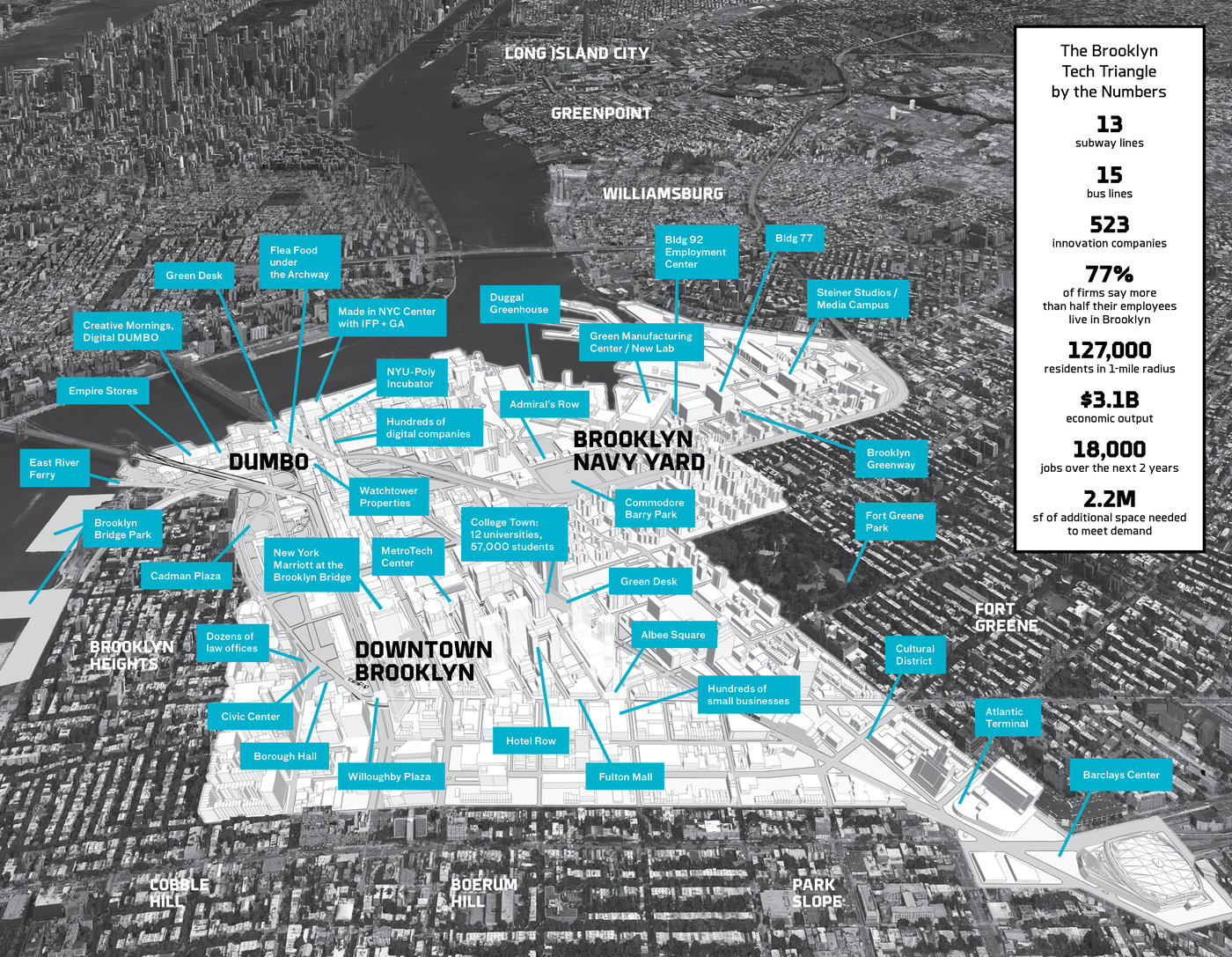
Strategic Plan to Reposition the Brooklyn Tech Triangle

The Brooklyn Tech Triangle, which includes the neighborhoods of DUMBO, Downtown Brooklyn, and the Brooklyn Navy Yard area is becoming the City’s largest cluster of tech activity outside of Manhattan, with nearly 10% of the sector calling this area home. Individually, these neighborhoods have attracted the interest of innovative tenants in the last several years, especially in DUMBO, which has become a recognized tech hub. The challenge of nurturing this influx of innovation requires ensuring that the right kind of space and environment is available for tech firms, and both opportunities and talent are encouraged. However, a lack of appropriate office space and adequate job preparation, among other factors, threatens to stifle this growth and send companies to invest and hire elsewhere. Led by the Downtown Brooklyn Partnership, the DUMBO Improvement District, and the Brooklyn Navy Yard Development Corporation, the Brooklyn Tech Triangle Strategic Plan seeks to address these challenges by providing a blueprint for nurturing the growth of this sector and ensuring New York can capitalize on the job creation of the industry.

As part of a consultant team led by WXY Architecture + Urban Design, HR&A spearheaded the real estate and economic analysis supporting policy recommendations to foster the area’s tech sector growth. HR&A helped develop a working definition of the target tech and creative industry sectors, assessed the current status of tech and creative companies in the Tech Triangle area, and recommended changes in public and private real estate development and management policies. The team as a whole also considered workforce development, transportation, and open space and streetscape strategies to foster the growth of the technology and creative economy in the area.


The final report focuses on actionable recommendations for implementation by both the public and private sectors, to nurture the growth of creative industries within the Tech Triangle while maximizing the employment benefits for local residents. The report describes five categories of recommendations to ensure that the Tech Triangle remains a world-class center for innovation and resources and the 2nd largest cluster of tech and creative companies for New York City: creating space for tech to grow, connecting Brooklyn’s educational institutions to the tech sector, improving physical connectivity across the district,  improving the urban fabric of the Triangle, and marketing Triangle-created new technologies, while also bolstering the digital infrastructure of the area.


Specific recommendations conceived and analyzed by HR&A included: a master lessee program to align tech tenants’ leasing preferences with traditional landlord financing requirements  and a special innovation district to create more active space for the innovation economy in existing storage and warehouse buildings.


As of January 2016, a number of the initiatives we described are underway, and the Tech Triangle is now home to 1,351 innovation companies and 17,302 employees, up from 1,107 and 11,967 in 2012, respectively. In November 2013, the New York chapter of the American Planning Association honored the Brooklyn Tech Triangle Strategic Plan with its annual award for Meritorious Achievement citing the ambitious scale of the plan to serve as a model for economic development in urban centers.

Los Angeles Mental Health Services Act Housing Program

HR&A collaborated with the Los Angeles County Department of Mental Health to design and implement the County’s Mental Health Services Act (MHSA) Housing Program. Within 12 months, the original MHSA funds were committed to 30 projects, and together with $131 million of supplemental funding added during subsequent years, the County deployed a total of $243 million to fund 92 developments with 5,400 units, 1,700 of which were targeted to vulnerable populations. 

The Mental Health Services Act (MHSA) Housing Program is a voter-approved initiative charged with expanding mental health services in the state of California. Among its many initiatives is a funding allocation to each county to provide pre-development, permanent financing, and capitalized operating subsidies for new, permanent supportive housing for persons with serious mental illness who are homeless or at risk of homelessness. From 2007 to 2019, HR&A served as chief housing consultant to assist with design and implementation of deploying the County’s initial $116 million share of the MHSA Housing program to provide capital and operating subsidy loans for service-enriched, permanent supportive housing for homeless Angelenos.  


HR&A helped Department of Mental Health staff design a process for screening and selecting development proposals for funding, perform initial due diligence review of successful application financing plans, facilitate coordination between the department staff and other funders, and assist the department and California Housing Finance Agency to complete underwriting review of loan applications.  


Explore 

Learn more about the program on Los Angeles County’s Mental Health Services Act Website 

PlaNYC & OneNYC

HR&A supported multi-agency, cross-disciplinary planning efforts for PlaNYC and led the creation of OneNYC, the City of New York’s  long-term plans.

The Bloomberg administration first developed PlaNYC in 2007 as the City’s bold plan for sustainable growth in New York City through 2030. HR&A provided policy advisory services for the creation of the initial plan and supported the development of an update in 2011. In 2015, HR&A worked closely with the Mayor’s Office to project manage the update to PlaNYC, incorporating Mayor de Blasio’s policy goals of equity and inclusion in OneNYC: The Plan for a Strong and Just City.

As project manager and lead advisor for OneNYC, HR&A worked with over 70 agencies and the Mayor’s Office to develop a plan focused around four visions for the City of New York: Growth, Equity, Sustainability, and Resiliency.

OneNYC will guide the city on a path of broad-based growth that includes all five boroughs and lifts up the city’s most vulnerable populations. HR&A worked with departments and agencies to set ambitious long-term targets and create major initiatives to support job creation, population growth, household income, housing affordability, and transit access to jobs for New Yorkers.

In addition to project management and agency coordination, HR&A implemented a community and stakeholder outreach initiative and prepared an in-depth policy analysis.

We worked with the Mayor’s Office to develop an outreach strategy to ensure that the voices of New Yorkers were incorporated into OneNYC. Through town hall meetings, elected official briefings, and a public survey, our team sought input from thousands of New Yorkers to understand how the City’s 30-year plan could better serve them. HR&A also prepared an analysis of the economic, demographic, and environmental trends influencing the city and its surrounding region today and in the future. This critical work led to the development of the Plan’s economic, transportation, and housing initiatives.

Mayor Bill de Blasio launched OneNYC on April 22, 2015.

The City subsequently proposed a 10-year capital strategy within its executive budget that included $22 billion in capital allocations to OneNYC initiatives. Prior to the launch, HR&A spearheaded an effort to create a database and map of $266 billion in planned future capital investment by the City and its regional and state partners. Our work on this will provide the City a valuable tool to inform and track future investment decisions.


HR&A also provided advisory services for the creation of the initial PlaNYC 2030, unveiled in 2007, and supported the development of an update in 2011, for which we provided policy support.

In 2007, HR&A served as project manager and lead advisor for the development of a long-range transportation plan under PlaNYC. We provided the foundation for the final policy initiatives, which created a comprehensive framework for future transportation planning in New York City. To cover the wide range of complex and interrelated issues related to transportation planning in the City, HR&A convened and led an interagency team with representation from the Mayor’s Office, the Department of Transportation, and the New York City Economic Development Corporation. The team evaluated the current state of local transportation systems, and drafted policy recommendations to improve and expand sustainable transportation infrastructure. In addition, HR&A identified strategies to spur brownfield redevelopment and in August 2010, then-Mayor Bloomberg launched the nation’s first municipal brownfield cleanup program.


In support of PlaNYC 2.0 in 2011, the first major update to PlaNYC, HR&A evaluated existing energy efficiency and clean distributed generation funding programs available to real estate owners and tenants in New York City. The firm examined existing energy program budgets and expenditures, and issued policy recommendations for improving the efficiency and effectiveness of the programs.


Single Sales Factor Tax Analysis

HR&A demonstrated the economic and fiscal benefits of the Single Sales Factor tax policy in New York City and State.

Single Sales Factor is a tax policy change that encourages companies to keep jobs and capital in New York City. HR&A worked on behalf of a consortium led by the Motion Picture Association of America—composed of Fortune 500 companies and including executives from The Walt Disney Company—to conduct an economic and fiscal impact analysis to demonstrate the benefits generated by establishing Single Sales Factor corporate taxation in New York City.

Based on HR&A’s findings, New York State signed into law legislation that contains single sales factor tax reform for New York City in 2009.


At the time of HR&A’s study in 2008, 20 states, including the State of New York had adopted Single Sales Factor apportionment. HR&A researched and reviewed academic analysis of jurisdictional tax policies across the 50 states, prepared an economic analysis of the proposed policy change for New York City, weighed evidence in support of and opposed to modifying corporate income taxes, and presented a policy proposal to senior New York City policymakers.

LAX Economic Impact Study

HR&A advised Los Angeles World Airports on the local and regional economic impacts of redeveloping and expanding Los Angeles International Airport.

HR&A prepared detailed regional and local economic impact analyses necessary to evaluate alternative Master Plan concepts for the future of the Los Angeles Airport (LAX) as they evolved over nearly 10 years, and through three different mayoral administrations.

Using extensive REMI and IMPLAN modeling, the firm projected future baseline economic conditions and forecasted conditions under alternative development scenarios. Our forecasts considered the City of Los Angeles, various subareas of the City, the County of Los Angeles, the other four urban counties in the region, and the five-county Southern California region as a whole.

HR&A also assisted senior management, City officials and other project team leaders to respond to questions from a wide range of elected officials and other local and regional leaders, and the general public, about the economic implications of the alternatives.

Our work with LAX led to airport economic impact work across the country.

  • In association with the Los Angeles Economic Development Commission and other consultants, HR&A estimated the economic value to Los Angeles of accommodating new transoceanic flights, like those associated with next-generation aircraft.
  • Prepared regional and local economic impact analyses for Chicago O’Hare International Airport’s O’Hare Modernization Program and alternatives, for the Chicago Department of Airports and the FAA.
  • Provided two rounds of regional economic impact analysis for future options to expand capacity at San Diego International Airport, first for the San Diego Association of Governments and then for the San Diego County Regional Airport Authority.
  • Contributed to the socioeconomic forecasts used by aviation consultants to the FAA to analyze future airspace and airport capacity in the New York City-Northern New Jersey-Connecticut-Delaware metro area.
  • Prepared an in-depth economic impact and fiscal impact analysis demonstrating that the Santa Monica Airport generates $275 million in direct and indirect economic activity for the City of Santa Monica, and supports almost 1,500 full- and part-time jobs.

Economic Impacts of Airbnb

On behalf of Airbnb, an online service for short-term vacation rentals, HR&A conducted an economic impact assessment of Airbnb rental activities in San Francisco and New York City.

Airbnb is a leader in the “sharing economy,” a new trend in the sharing of resources facilitated by network technologies and social tools, and HR&A’s reports are among the most in-depth studies to date of the impacts of this economic trend.

The studies reveal multiple ways in which the new economic activities associated with Airbnb — which has grown exponentially since 2008 to serve 9 million guests in cities around the world — have significant impacts on a city and its neighborhoods, businesses, and residents:

  • Airbnb benefits its many hosts, who use Airbnb to supplement their income;
  • Airbnb impacts neighborhoods that are off the main hotel beat, distributing visitor spending across many neighborhoods and businesses throughout the city;
  • Airbnb benefits the city as a whole. In San Francisco, it generated $56 million in direct and indirect spending in one year and supported 380 full-time equivalent jobs. In New York, it generated $632 million in economic activity in New York and supported 4,580 jobs throughout all five boroughs.;
  • Much of this economic activity is new. Even as hotel occupancy has climbed, the number of Airbnb reservations has grown dramatically, indicating that many Airbnb users are a different visitor segment than hotel guests. Airbnb brings new economic spending to cities from visitors who are price-sensitive and seek a “live like a local” experience they may not otherwise find in conventional accommodation; and
  • Airbnb also enables cities to become more competitive by attracting skilled workers and incentivizing relocation with innovative short-term stay opportunities.

HR&A’s studies have been covered by WNYC, The Wall Street Journal, Business Insider, Real Estate Weekly, Media Post, New York Business Journal, Digital Journal, Tech Hive, Curbed,Morningstar, Forbes, TechCrunch, Marketwire, and The Huffington Post, among other news sources. It also attracted substantial attention from policy experts, and elected officials. The official press release for the New York Study is available online.

Image Courtesy of: Airbnb

Economic-Impact-of-Film-Production-Tax-Credits

Assessing the Economic Impacts of Film Production Tax Credits

HR&A has analyzed the economic impacts of film production tax credit programs in New York, Massachusetts, and Louisiana to support key policy goals on behalf of the Motion Picture Association of America.

New York

New York has a long and illustrious history as a center of film and television production. To remain an attractive place for filming and production, New York State enacted the Empire State Film Production Tax Credit, which has supported over 700 film and television projects since its 2004 inception.  In 2012, our study of the New York State Film Production Tax Credit demonstrated the credit’s essential role in bolstering the state’s thriving film and television production industry, generating 28,900 jobs and $6.9 billion in spending. Following the study’s release, Governor Andrew Cuomo released a proposed budget containing a five-year extension of the credit. The extension and enhancement of the state’s film and television tax credit will provide the stability necessary to attract more long-term investments and create more jobs for New Yorkers all across the state. The extension expanded the scope of projects eligible for the credit, accommodates the rise of visual effects spending as a portion of overall budgets, and included provisions to drive more film production and post-production in upstate New York.


Massachusetts

In 2013, HR&A assessed the economic and fiscal impacts of the Massachusetts Film Production Tax Credit Program. Our analysis estimated  jobs, wages and economic output generated from filming and post-production activities, and considered the economic impact of production as well as the spending associated with film tourism,  infrastructure investments for production facilities, and value from media exposure. We found, that the tax-credit program generated 2,200 jobs in 2011 and $375 million in state spending, and also significant infrastructure investment. Following the release of our study, the state legislature rejected a budget amendment that would have capped the Commonwealth’s investment in the incentive program.


Louisiana

HR&A examined the dramatic growth of the Louisiana motion picture and television industry, in our economic and fiscal impact analysis of the Louisiana Motion Picture Investor Tax Credit  on behalf of the Motion Picture Association of America and the Louisiana Film and Entertainment Association. The analysis considered three major sources of economic impact – direct production spending, visitor spending attributable to film-induced tourism, and construction of studio and other production infrastructure. The Louisiana State Legislature enacted the credit in 2002, and adjusted it to a 30% tax credit on all qualified Louisiana production spending and a 5%  tax credit on Louisiana resident payroll in 2009.


From 2002 to 2013, film and television production employment increased by over 5,000 jobs, with estimated production spending of over $1 billion in 2013. In 2013 – considering both production spending and visitor spending attributable to motion picture and television tourism – the credit supported up to 33,520 jobs in Louisiana across all industries, generating up to $1.2 billion in personal income and up to $4 billion in economic output in Louisiana. In particular, visitor spending attributable to motion picture and television induced tourism in the state supported up to 22,720 jobs in Louisiana, generating up to $767 million in personal income and up to $2.4 billion in economic output. The tourism impacts are based on a survey of 1,381 recent visitors to Louisiana conducted by HR&A and Federated Sample, which found that 14.5% of domestic, out-of-state, leisure visitors can be considered motion picture- and/or television- induced tourists.


In all of these studies, HR&A used IMPLAN modeling to estimate the full economic benefits of the film credits, capturing the results in terms of jobs, wages, and economic output generated. HR&A also examined the fiscal impacts of the credits, in terms of state and local tax revenues. In all cases, HR&A’s final reports helped demonstrate the value of these types of tax credits for each state.