
on Jan 20, 2026
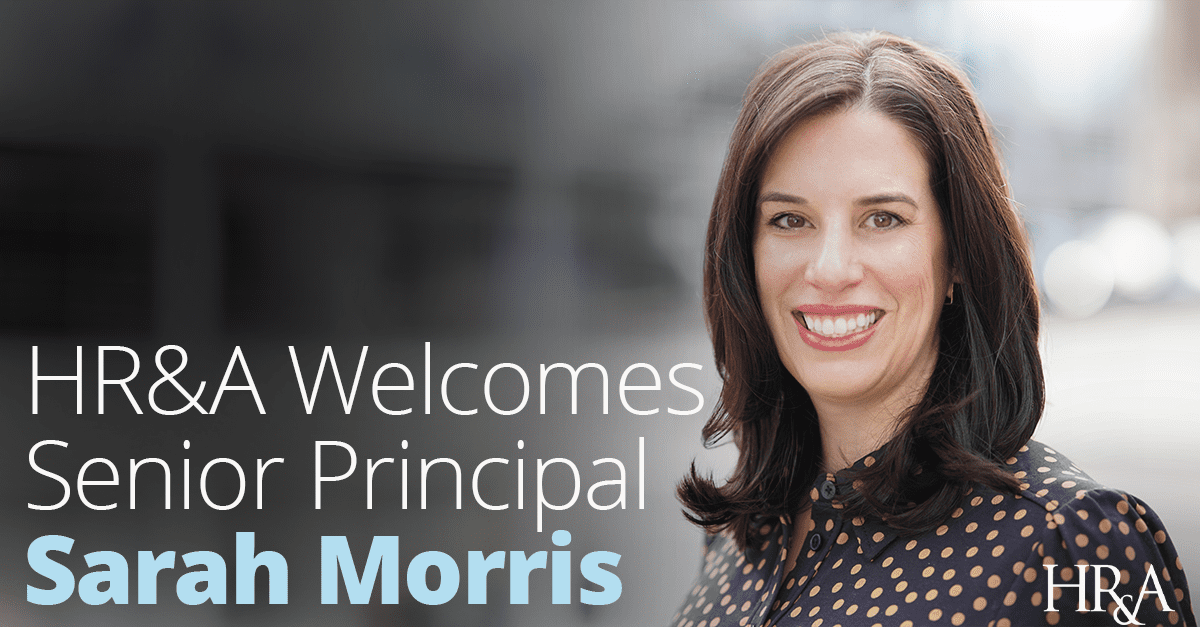
HR&A Welcomes Senior Principal Sarah Morris
HR&A Welcomes Senior Principal Sarah Morris
With two decades of experience at the intersection of technology and public policy, Sarah brings unparalleled expertise in broadband access, digital equity, and public interest technology. She comes to HR&A fromleading roles at the Open Technology Institute and the National Telecommunications and Information Administration (NTIA), where she helped stand up nearly $50 billion in federal broadband programs, including the landmark BEAD initiative. We sat down with Sarah to discuss her journey, what drew her to HR&A, and her vision for closing the digital divide.
Can you share a little about your background?
I’ve spent the past two decades working on broadband access and adoption issues. I was born and raised in Omaha, Nebraska, and while earning my JD and Master of Laws in space, cyber, and telecommunications law at the University of Nebraska-Lincoln, I became interested in the dichotomy between the fast-paced transformations of the tech world and the slow evolution of the laws that govern it.
That realization brought me to Washington, DC., where I started as a fellow at Media Access Project, which provided legal support to public interest advocacy organizations working on technology policy. From there, I moved to the Open Technology Institute at New America, where I spent 12 years building the broadband access and adoption practice and ultimately serving as executive director.
In early 2022, I joined the Department of Commerce at the National Telecommunications and Information Administration (NTIA), the agency that serves as the president’s principal adviser on tech and telecommunications issues. At NTIA, I launched grant programs to invest $50 billion to support broadband access and adoption. I led the mapping team that worked with the FCC and states to ensure broadband availability maps were ready for announcing state funding allocations.
Halfway through my tenure, I became deputy administrator, which broadened my portfolio to include public safety issues like FirstNet, our first responders network, and the Wireless Innovation Fund, which supports transformative new wireless technologies.
What brought you to HR&A?
I spent so much time in government standing up these critically important programs, and now they’re very much in the implementation phase, where the rubber hits the road. HR&A has a strong track record of supporting state broadband offices, industry partners, and communities implementing the BEAD program.
More broadly, the opportunity to work alongside colleagues across the firm on housing, healthcare, workforce development, and economic development is compelling. We can’t think about technology policy as separate from housing, healthcare, workforce development, and economic development. It’s foundational to how we solve public policy challenges today. The chance to work with incredible people on the top policy issues of our time and integrate technology into that problem-solving is what excites me about being here.
What do you see as the future of broadband and digital opportunity?
I think about this in two ways: near-term and long-term.
Near-term, we simply have to get people connected. There’s no excuse for communities to lack internet access or for people not have the tools they need to get online and actually use that access. The immediate future is finally closing the digital divide using every tool at our disposal—both inside and outside government.
Long-term, we need to understand that technology policy isn’t its own isolated thing. Technology issues are the backbone of every public policy problem we confront. The future of broadband and digital opportunity involves recognizing the wholly integrated nature of both the problem and the solution.
For example, if you look at the widespread deployment of AI tools and their rapid adoption by individuals, industries, and policymakers, you can see how the challenges these tools create aren’t limited to a narrow technology policy slice. Figuring out how to support clients and partners in thinking about these issues as fully integrated. That’s the longer-term phase of this work, and that’s where I’m focused.
Learn more about Sarah Morris.