on Apr 30, 2026
AI could leave thousands of NY’s studio apartments empty
This op-ed was originally published by Crain’s New York Business and authored by Partner Kate Wittels and Principal Sulin Carling.
Elected officials and business leaders describe New York City as the most resilient city in the world, bouncing back stronger from every shock and adapting to a new normal. Today, the shock is AI.
AI promises unprecedented productivity gains, but it poses real challenges for a core engine of New York’s economic growth: the steady pipeline of college graduates eager to build their careers here. Six percent of all U.S. college graduates move to New York after graduation. In the last four years, this equated to approximately 490,000 college grads moving to the city, roughly double the number moving to Los Angeles, the second-highest city.
With the rapid adoption of AI, corporations are putting that pipeline under threat. Entry-level job postings in New York have already dropped 37%, so much so that Gov. Kathy Hochul has launched the FutureWorks Commission to rethink workforce development. And Dario Amodei, CEO of Anthropic, has predicted that AI could eliminate up to 50% of entry-level white-collar jobs over the next five years.
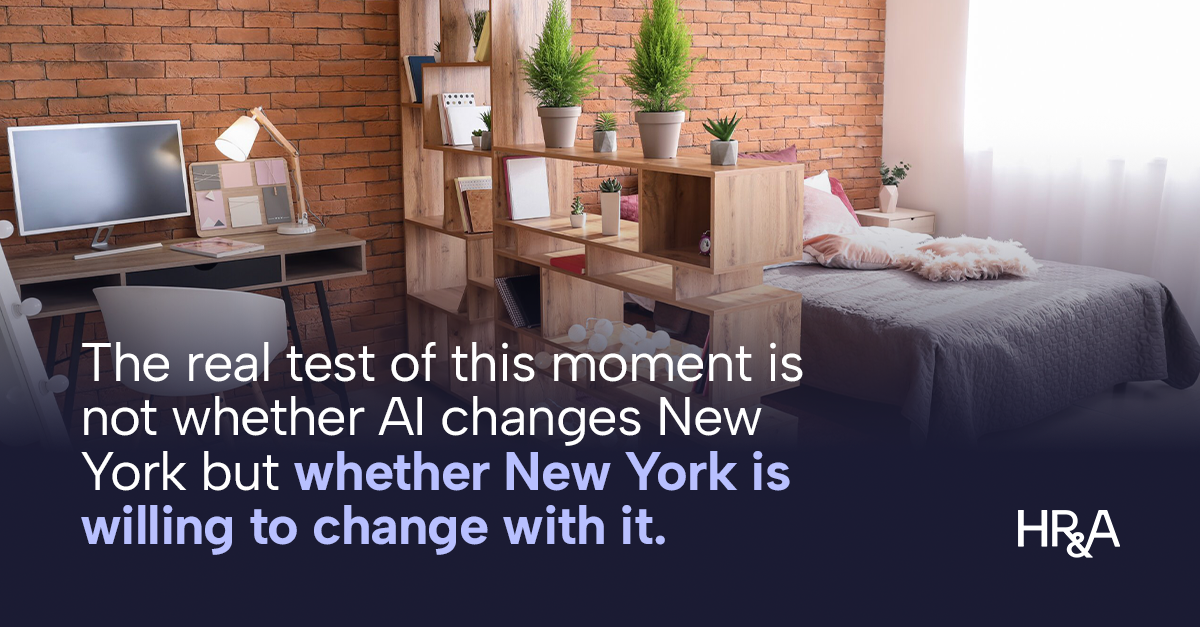
For decades, New York’s housing development patterns have been organized around serving this workforce. Studios and one-bedrooms dominate, designed for renters willing to trade space for proximity to the city’s parks, restaurants and energy. Since 2000, nearly 45% of new units built citywide have been studios or one-bedrooms.
This pattern is not accidental. It reflects what “pencils out” on developers’ balance books: Smaller units command higher rents per square foot. With limited developable land, New York has effectively concentrated its housing production around one set of assumptions about who will live here and how they will earn a living. That has come at the expense of housing that works for low- and middle-income New Yorkers, including families, multi-earner households, and those whose incomes do not align with luxury rents on a per-square-foot basis. Reductions in entry-level roles may boost short-term efficiency for individual firms, but they pose real risks to New York’s broader economic ecosystem.
A weaker pipeline of young professionals will ultimately make it harder for companies to develop talent, evolve and grow. Business leaders should recognize that workforce decisions don’t operate in isolation. If AI reduces the number of entry-level white-collar jobs, the implications extend beyond the labor market. They reach into the composition, pricing and long-term adaptability of our housing stock.
If demand for studios and one-bedrooms softens, developers and policymakers will need to grapple with how to absorb a housing stock heavily weighted toward small units, how to adapt existing buildings, and how to ensure that new development reflects a broader range of household types. Financing norms and inertia will continue to push developers toward the same unit mix unless there is a deliberate adjustment in how projects are underwritten and approved.
Unwittingly or not, New York’s leading employers and its housing developers are making decisions that are deeply interconnected. If companies embrace a future with fewer entry-level roles, they are not just reshaping their business model, they are reshaping who is demanding housing. And if that demand shifts, the housing industry cannot continue building as if nothing has changed.
A city that no longer needs as many entry-level workers cannot continue to build as though it does. Otherwise, we will have empty offices paired with underutilized studios and one-bedrooms, and a housing shortage that still fails to serve the families and workers who remain.
Resilience has always defined New York, but resilience is not automatic. It requires adaptation, coordination and trade-offs. Employers must recognize that sustaining a robust entry-level ecosystem is not altruism; it is an investment in the long-term vitality of the city that fuels their success. At the same time, developers and policymakers must broaden their assumptions about who New York is for and align new housing for a changing workforce.
The real test of this moment is not whether AI changes New York but whether New York is willing to change with it.